- "Maintaining a Proud Tradition of Excellence since 1885"
- 973.664.0250
- info@sanitaryconstruction.com


Paving the Way for Winter: How Proper Drainage and Grading Protect NJ Sites from Seasonal Damage
December 15, 2025
NJ Wastewater System Installation: What Municipal Engineers Need to Know
February 13, 2026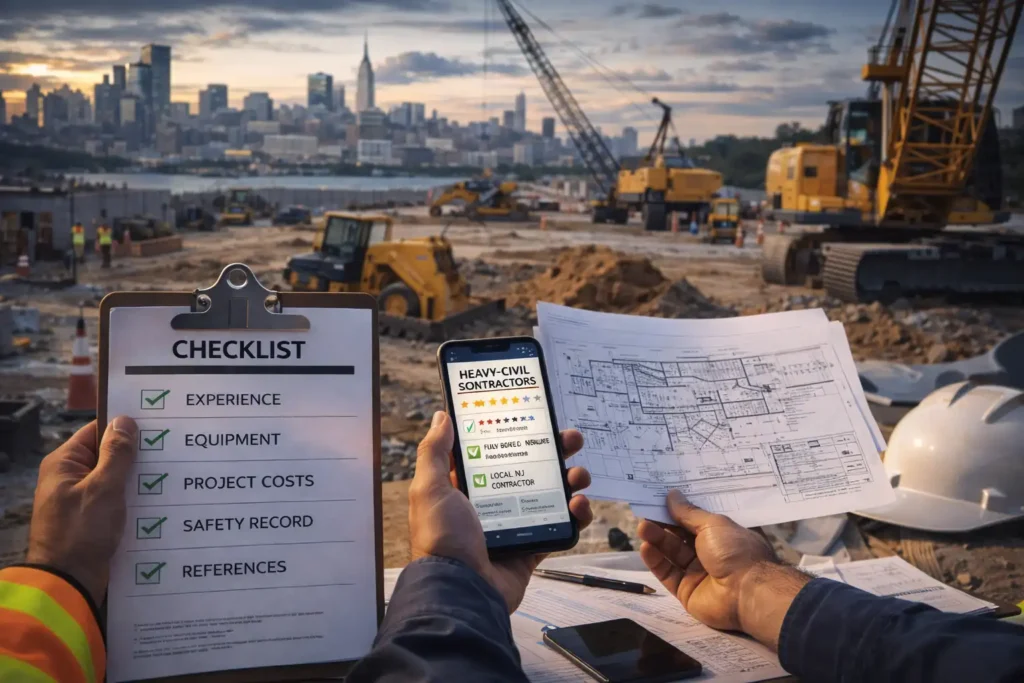
Selecting the right heavy-civil site contractor in New Jersey is one of the most consequential decisions a project owner, developer, or municipal engineer will make. The wrong choice leads to missed deadlines, cost overruns, regulatory violations, and, in the worst cases, rework that doubles the original budget. The right contractor — one with deep NJ-specific experience, self-performance capability, and a proven safety record — becomes an extension of your project team.
This guide walks through the critical factors that differentiate qualified heavy-civil site contractors in New Jersey, from technical prequalification and safety credentials to local market knowledge and workforce depth. Whether you are procuring for a municipal infrastructure project, a commercial land development, or a utility system expansion, these criteria apply.
1. Verify NJDOT Prequalification and Bonding Capacity
For any public project in New Jersey, NJDOT prequalification is a baseline requirement — not a differentiator. Contractors must be prequalified in the relevant work categories (earthwork, utility installation, road construction, etc.) and carry adequate bonding capacity for the contract value. Before issuing an RFQ, confirm that prospective contractors hold current prequalification status and that their bonding capacity covers your project scope with room to spare.
Bonding capacity also signals financial stability. A contractor with a $50M bonding line is fundamentally different in organizational depth than one capped at $5M, even if both can technically perform the work on paper.
2. Understand Self-Performance vs. Subcontracting
One of the most overlooked distinctions in contractor selection is self-performance ratio. Some contractors operate largely as brokers — they win the bid and immediately subcontract 60 to 80 percent of the work. This introduces coordination risk, accountability gaps, and quality control challenges at every handoff.
A contractor that self-performs the majority of its work controls its own schedule, its own workforce, and its own quality standards. This is especially critical for complex scopes involving earthwork, utility installation, and pavement in close sequence — the kind of integrated site work where delays compound rapidly.
When evaluating bids, ask each contractor to provide their self-performance percentage by trade. Request a breakdown of which scopes they will perform with direct employees versus which they plan to subcontract.
3. Evaluate Safety Record and Third-Party Certifications
Heavy-civil construction carries inherent risk. Excavation, underground utility work, and road construction are among the highest-hazard activities in the industry. A contractor’s safety record is a direct proxy for the quality of their workforce management, supervision, and operational discipline.
Key metrics to evaluate include the Experience Modification Rate (EMR) — ideally below 1.0 — Total Recordable Incident Rate (TRIR), and Days Away, Restricted, or Transferred (DART) rate. These figures are auditable through ISNetworld, which is a third-party safety and contractor management platform used by major NJ utilities including NJ American Water.
In addition to ISN registration, look for contractors participating in the Gold Shovel Standard program, which signals a commitment to safe excavation practices and damage prevention around underground utilities.
4. Assess Local NJ Regulatory Knowledge
New Jersey’s regulatory environment for site development is among the most complex in the country. NJDEP oversight, NJPDES stormwater permits, wetlands buffers, stream encroachment permits, and site remediation requirements all interact with heavy-civil scopes in ways that demand contractor-level familiarity — not just engineer-level familiarity.
A contractor who has worked in New Jersey for decades understands the practical implications of these regulations on construction sequencing, inspection scheduling, and documentation requirements. That institutional knowledge reduces risk for the project owner and shortens the learning curve when issues arise in the field.
5. Review Past Performance on Comparable Projects
Request a past performance list that specifically includes projects comparable to yours in scope, contract value, and client type. A contractor with an extensive portfolio of municipal wastewater projects brings different institutional knowledge than one whose resume is predominantly private developer work — even if both are technically qualified.
Ask for references from public agency clients, utility owners, and repeat developer clients. A high repeat client percentage is one of the strongest indicators of contractor reliability — clients who return to the same firm are doing so based on demonstrated performance, not price alone.
6. Consider Equipment Fleet and Workforce Depth
Heavy-civil site work is equipment-intensive. Contractors who own their fleet rather than renting can mobilize faster, respond to equipment issues without waiting on third-party vendors, and maintain consistent operating standards across their machinery. Ask for a summary equipment list and confirm that the contractor’s fleet is appropriate for your project’s scope and ground conditions.
Workforce depth matters equally. In northern New Jersey’s competitive labor market, contractors who maintain long-term relationships with their craft workforce — particularly operating engineers, laborers, and teamsters — have a meaningful advantage in mobilizing and retaining capable crews.
Conclusion
Selecting a heavy-civil site contractor in New Jersey requires looking beyond the bid price. Prequalification, self-performance ratio, safety credentials, local regulatory knowledge, and documented past performance are the substantive differentiators that determine project success. Take the time to evaluate these factors rigorously, and the right contractor will deliver not just a completed project, but a long-term professional relationship built on performance.
Ready to discuss your project? Contact Sanitary Construction Company at (973) 664-0250 or info@sanitaryconstruction.com. Visit us at sanitaryconstruction.com.